


Description
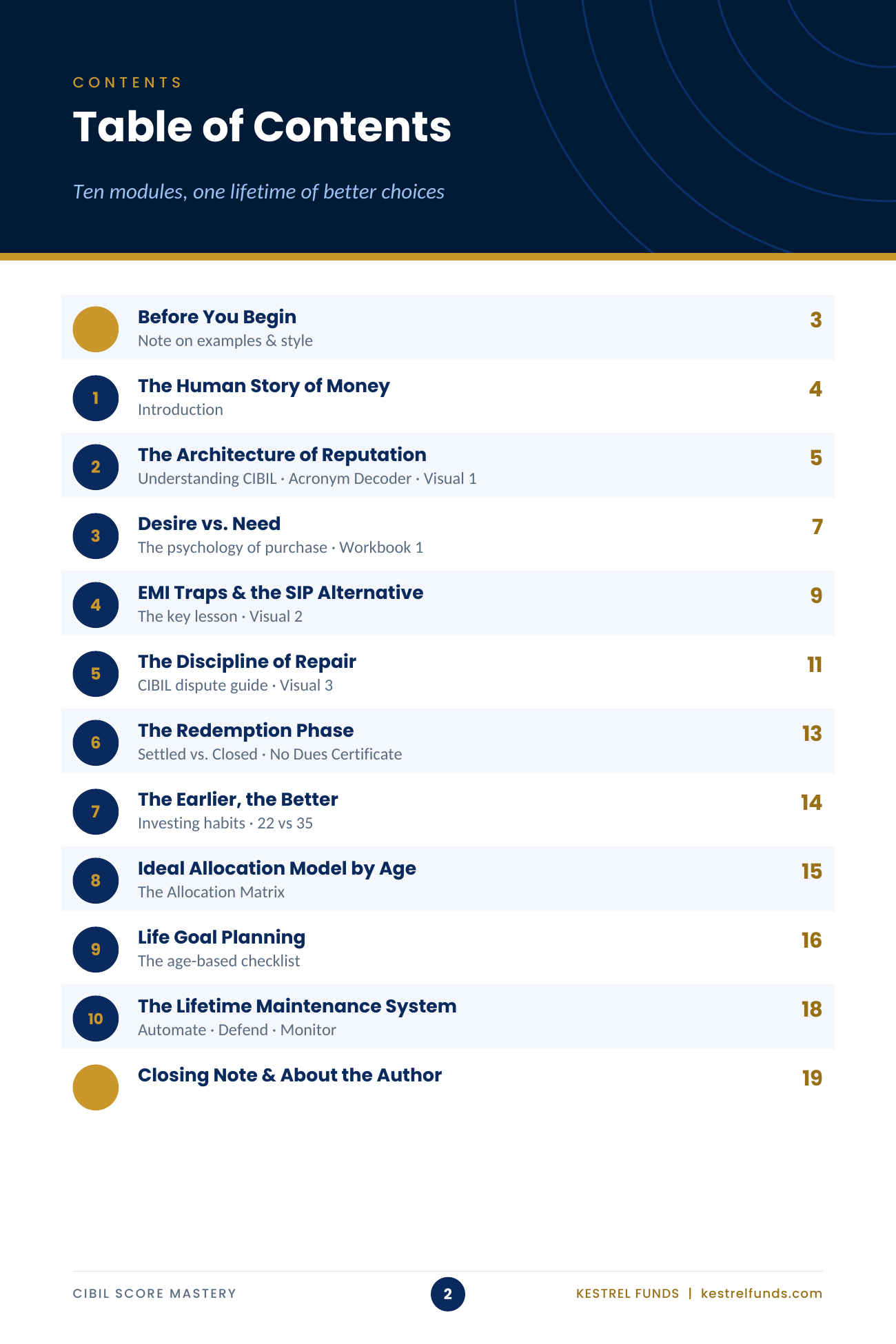
The Architecture of Money (by Adesh Katariya, Kestrel Funds) is a plain-language guide to credit, debt and long-term wealth for Indian readers. It treats money as a human choice, not just mathematics. It has ten modules.
Module 1: The Human Story of Money. Your CIBIL score (300 to 900) is your financial reputation. Two neighbours with the same income and loan, Suresh (785) and Meera (640), end up with different scores because of a few years of small, repeated choices. A low score is a record, and records can be corrected.
Module 2: The Architecture of Reputation. It explains what CIBIL is and decodes terms like DPD, SET, CLSD, WO, FOIR and LTV. It also covers five pillars of scoring: payment history, credit utilisation (keep it under about 30%), enquiries, credit mix and length of history.
Module 3: Desire vs. Need. The N.E.E.D. test (Necessity, Emergency, Earnings fit, Delay) helps separate wants from needs. A workbook scores a purchase from 0 to 16: 0 to 6 is desire, 7 to 11 is a grey zone, and 12 to 16 is a genuine need.
Module 4: EMI Traps and the SIP Alternative. This is the book’s key lesson. For an ₹80,000 phone over 12 months, the EMI path costs ₹6,648 in interest and leaves you with a depreciating phone. The SIP path (same monthly amount in a low-risk debt fund) leaves you about ₹10,000 ahead after paying cash. The book says short-term goals belong in low-risk options, not equity.
Module 5: The Discipline of Repair. It gives a step-by-step guide to disputing errors on your CIBIL report (inaccuracies, ownership errors, duplicates). It also describes a 30-day dispute timeline, escalation to the nodal officer and RBI Integrated Ombudsman, and the ₹100 per day compensation for delays.
Module 6: The Redemption Phase. Settled means you paid less than owed, while Closed means you paid in full. Moving from Settled to Closed is not automatic, so ask the lender in writing. A six-step No Dues Certificate process and a sample request letter are included.
Module 7: The Earlier, the Better. Priya starts a ₹5,000 monthly SIP at 22 and Rahul starts at 35, both stopping at 60. At 12% a year, Priya ends with about ₹4.67 crore and Rahul about ₹94.9 lakh. Time matters more than the amount invested.
Module 8: Ideal Allocation by Age. It gives age-wise splits across equity mutual funds, debt funds, FDs, bonds and shares. Equity is 50% in your 20s and 30s, falling to 25% in your 50s and beyond. The suggested SIP is 15% to 25% of income.
Module 9: Life Goal Planning. Your 20s are for the foundation: a 6-month emergency fund, health and term insurance, and a first SIP. Your 30s are for home and children’s education, and your 40s for the marriage fund and clearing high-interest debt. Your 50s are for retirement security, loan clearance and a will. Examples show how inflation raises future costs.
Module 10: The Lifetime Maintenance System. Automate (auto-debits and a SIP on salary day), Defend (never share OTPs, avoid risky loan apps, apply rarely) and Monitor (monthly, 6-monthly and yearly checks). It ends with a one-page personal commitment sheet.
Closing note: Start with one step this week. Check your CIBIL report, set up one auto-debit, or start a ₹1,000 SIP.
All numbers and characters in the book are illustrative, and it is general education, not personal financial advice.
Agar aap chahein toh main teeno books ka ek combined comparison bhi bana sakta hoon.





Reviews
There are no reviews yet.