


Description
CIBIL Score Mastery: Premium Practical Guide (Adesh Katariya, Kestrel Funds, October 2026) is the long reference edition of the CIBIL guide. It has 25 chapters, each about 8 pages. It is meant to be worked through with your own report open, not read once.
Front matter
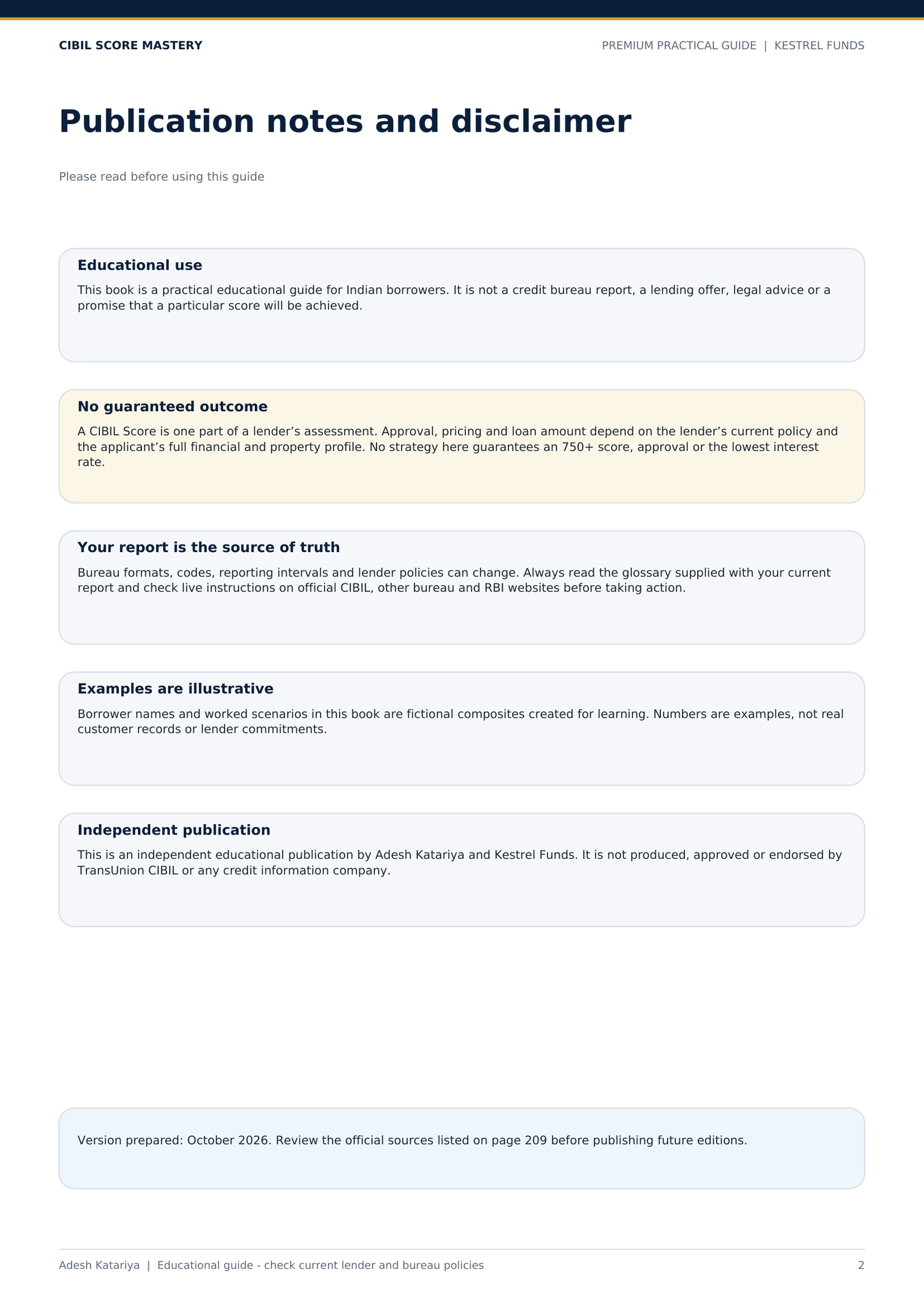
- Disclaimer and author note: It is educational only, it guarantees no score, and it is not endorsed by TransUnion CIBIL. Examples are fictional.
- How to use the book: It maps questions to chapters. For example, “What does DPD mean?” points to Chapters 5 and 10, and “I found an error” points to Chapters 3, 19 and 20.
- The core rule: Never take a new loan just to raise your score. Every credit decision should make sense even if the score doesn’t move.
- Introduction: 750+ is treated as a goal, not a promise. Lenders also assess income, obligations and documents.
Chapter structure. Every chapter has the same eight pages: overview, how the detail works, what to check in your report, a case study, common traps, an action plan, a worksheet, and a recap with a self-check.
Part 1: Understanding the report (Ch. 1 to 3)
- Ch. 1: Your credit file. The score, the report and the bureau are different things. Read the report in layers: identity, accounts, payments, then enquiries.
- Ch. 2: The 300-900 scale. 750+ is a target, and there is no public formula to calculate your exact score.
- Ch. 3: Reading your report. Match every field against your own documents and spot identity mismatches first.
Part 2: The factors behind the score (Ch. 4 to 11)
- Ch. 4: Payment history. Build a system that works in your busiest month: one calendar, reminders 3 to 5 days early, and a funded auto-debit account.
- Ch. 5: DPD decoded. How to read the monthly grid, where 000 means no late payment and numeric values show days late.
- Ch. 6: Enquiries. An enquiry is not a loan sanction. Apply deliberately and keep an enquiry log.
- Ch. 7: Utilisation. Balance divided by limit matters even if you never miss a payment. A ₹1.8 lakh balance on a ₹2 lakh limit reads as heavy use.
- Ch. 8: Credit age. Don’t close old accounts in a hurry, but weigh fees and security risks.
- Ch. 9: Credit mix. Borrow for a reason, not for a score.
- Ch. 10: Account status. Active, Closed, Settled and Written Off. Check status and balance separately, and keep closure documents.
- Ch. 11: Codes and short forms. DPD, STD, SMA, SUB, XXX and others. Your own report’s glossary always takes priority.
Part 3: Fixing problems (Ch. 12 to 13)
- Ch. 12: Diagnose a low score. Build an issue register with three columns: data error, repayment or cash-flow issue, and usage pattern.
- Ch. 13: Recovering after late payments. Confirm the exact overdue amount and fees, stop the problem spreading to next month, then fix the cause.
Part 4: Products and relationships (Ch. 14 to 18)
- Ch. 14: Credit cards. Understand the statement cycle. The minimum due is not the full due. A card works best when it is boring.
- Ch. 15: Personal loans, consumer finance and BNPL. Small instalments add up, so calculate the total across all of them.
- Ch. 16: Home-loan preparation. Check reports early and prepare your credit, income and property files together.
- Ch. 17: Choosing a lender. Compare suitability, not just rate. Keep an application log.
- Ch. 18: Joint borrowers, guarantors and add-on cards. Someone else’s repayment can become your issue, so read the contract before signing.
Part 5: Disputes, safety and special cases (Ch. 19 to 22)
- Ch. 19: Disputes. Point to a specific field with evidence. “My score is wrong” is too vague to investigate.
- Ch. 20: After a settlement or write-off. Document every step, get written terms and confirm how the lender will report it.
- Ch. 21: Fraud and unknown accounts. Secure your logins first, then verify, contact the lender and dispute.
- Ch. 22: Salaried, self-employed and variable income. Plan EMIs around a conservative month and keep business and household accounts separate.
Part 6: Lending basics and action (Ch. 23 to 25)
- Ch. 23: Underwriting basics. EMI, FOIR, LTV and affordability. The loan you qualify for is not always the loan you should take.
- Ch. 24: 90-day plan and 12-month routine. Days 1 to 30 are an audit, days 31 to 60 stabilise payments and balances, and days 61 to 90 verify updates. It tracks behaviours, not just the score.
- Ch. 25: Practical toolkit. Letters, case files and printable trackers. It also covers a secure folder for dated reports, payment proofs, NOCs, settlement letters and dispute IDs.
Back matter. Page 209 lists official references from TransUnion CIBIL and RBI for verifying details, and page 210 is the end cover.
Compared with the shorter 25-page edition, this one covers the same topics in much more depth, with a worksheet and case study per chapter. It also adds chapters on DPD codes, fraud, guarantors, BNPL and variable-income borrowers.
I haven’t read every page in full. This summary is based on each chapter’s overview and the contents and closing pages. If you’d like a deeper summary of any particular chapter, tell me which one.





Reviews
There are no reviews yet.