
Description
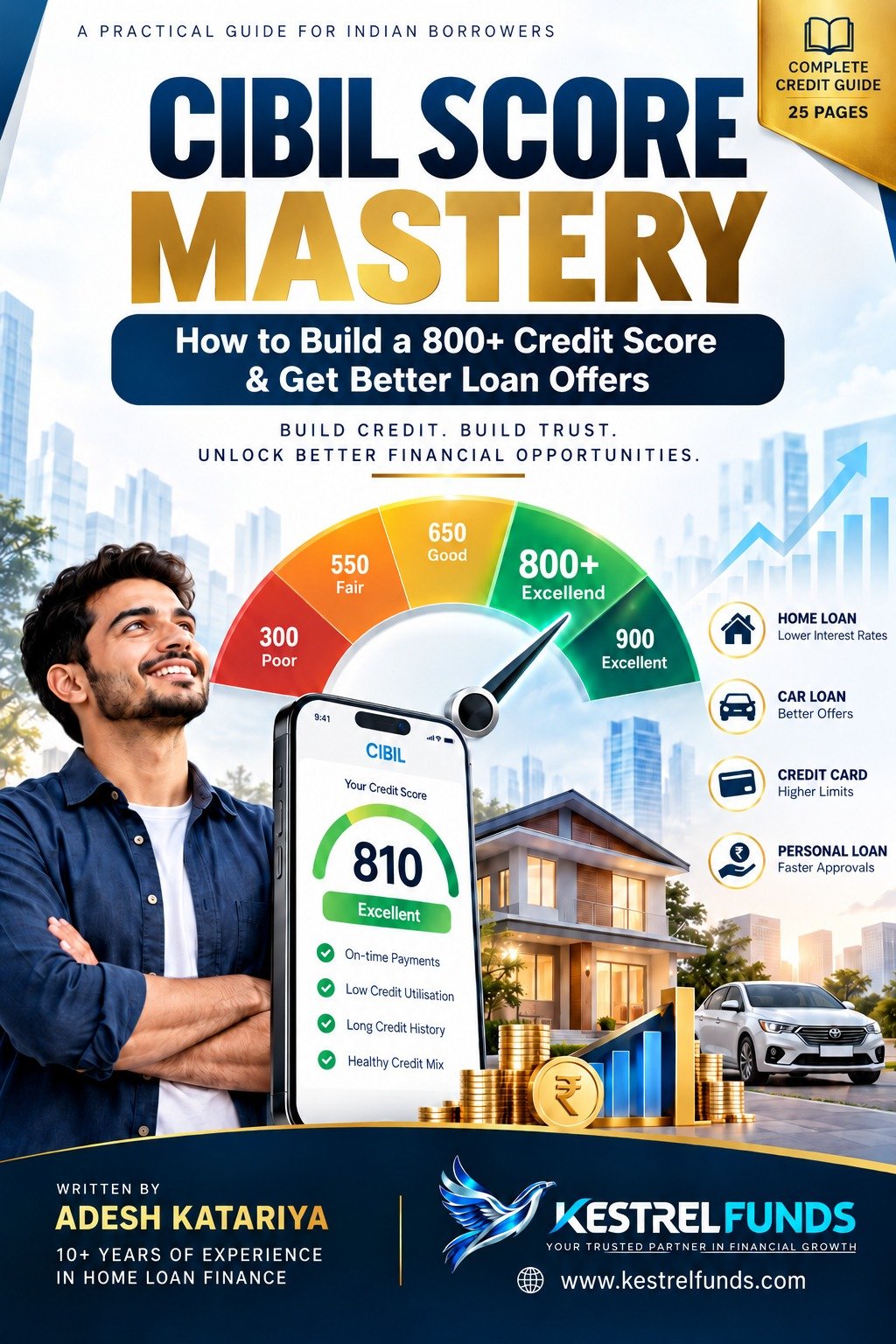
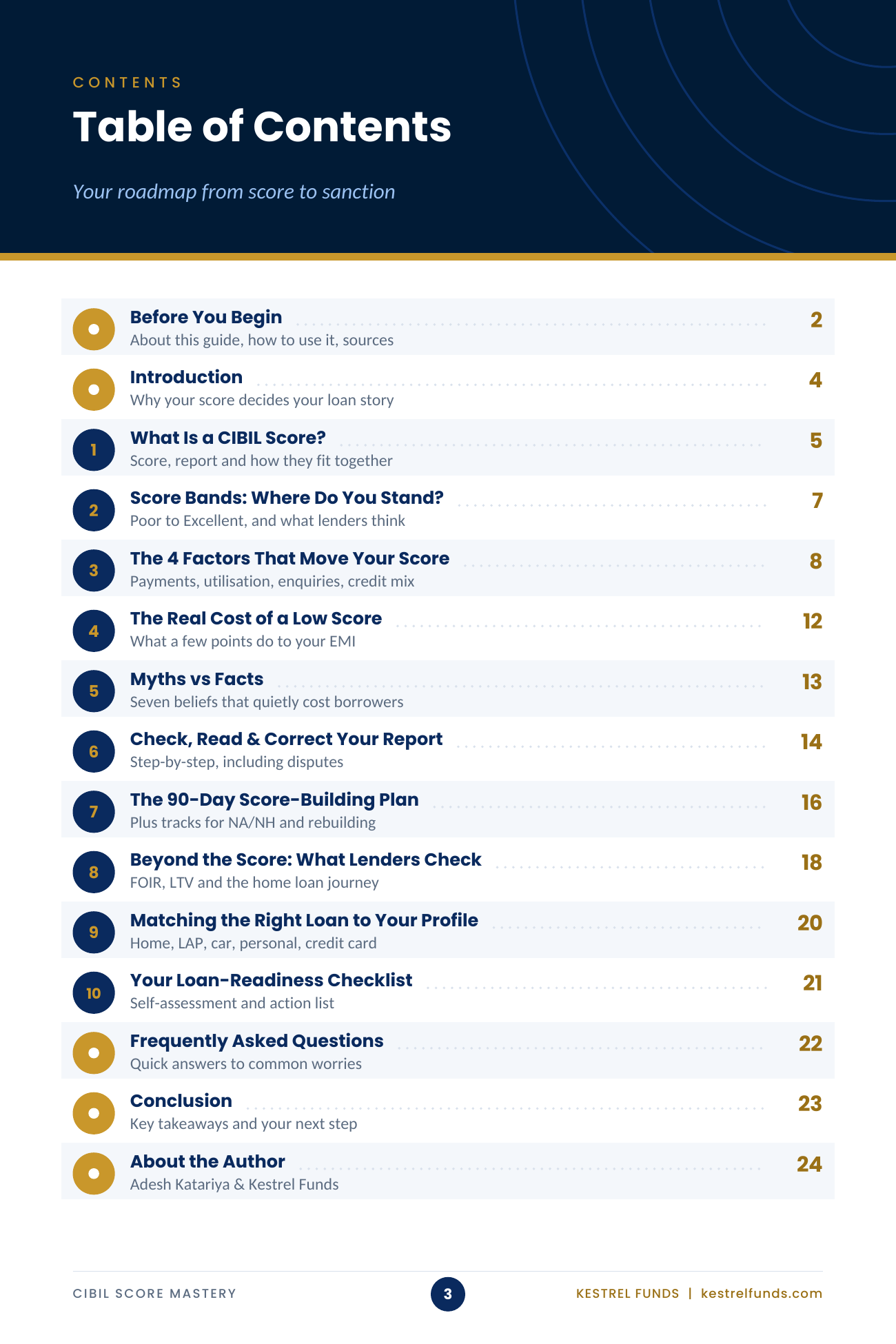
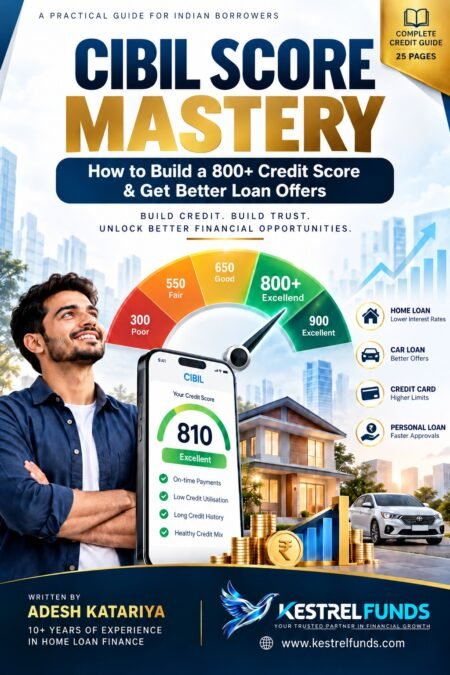
CIBIL Score Mastery (by Adesh Katariya, Kestrel Funds) is a 25-page practical guide for Indian borrowers on building a 750+ credit score and getting better loan offers. I already read this PDF earlier in our chat, so this summary comes from that.
Introduction: Your score is your financial reputation. Most people check their score only after a loan is delayed or rejected. Rohan (785) and Meera (640) earn the same and want the same ₹50 lakh home loan, but Rohan gets faster sanction and room to negotiate a lower rate. The goal is a 750+ score and a clean report.
Chapter 1: What is a CIBIL score? It is a 3-digit number from 300 to 900 built from the Accounts and Enquiries sections of your report. The report has five sections: Personal, Contact, Employment, Account and Enquiry information, with up to 36 months of payment history. “NA” or “NH” means you are new to credit, not that your score is bad.
Chapter 2: Score bands. The bands are Poor (300 to 549), Fair (550 to 649), Good (650 to 749), Very Good (750 to 799) and Excellent (800 to 900). A score is a guide, not a guarantee, because lenders also look at income, EMIs and their own policy.
Chapter 3: The 4 factors that move your score.
- Payment history has the highest influence. Automate EMIs, pay the full card bill, and make sure closed loans show as “Closed”, not “Settled”.
- Credit utilisation: keep it under about 30% of each card’s limit, and pay before the statement date.
- Enquiries: applying for credit leaves a mark, but checking your own score does not hurt it.
- Credit mix: a blend of secured and unsecured credit helps. Don’t borrow just to improve your mix.
Chapter 4: The real cost of a low score. On a ₹50 lakh, 20-year home loan, the rate difference between 8.50% and 10.00% means about ₹11.66 lakh more in interest. The EMI is about ₹4,860 higher every month. These rates are illustrative, not offers.
Chapter 5: Myths vs facts. Checking your own score doesn’t lower it. Income isn’t a score factor. Closing old cards can hurt. Paying only the minimum is costly. “Settled” is not the same as “Closed”.
Chapter 6: Check, read and correct your report. It explains how to download and review your report, verify your identity data and accounts, and check enquiries. You can dispute errors in three categories: inaccuracies, ownership errors and duplicates. For slow resolution, RBI’s framework provides ₹100 per day compensation after 30 days.
Chapter 7: The 90-day score-building plan.
- Days 1 to 7: audit your report.
- Days 8 to 30: stabilise with auto-debit, clear overdues and file disputes.
- Days 31 to 60: optimise by bringing utilisation under 30% and pausing new applications.
- Days 61 to 90: prove it by keeping every payment on time and re-checking your report.
Separate tracks cover people new to credit and people rebuilding a low score. Ninety days builds momentum, not miracles, and defaults take much longer to recover.
Chapter 8: Beyond the score. Lenders also check income stability, FOIR (the share of income already committed to EMIs), property value and LTV, age and tenure, and documents. The book walks through a 7-step home loan journey and lists documents for salaried and self-employed applicants. It also mentions balance transfer if your score has improved.
Chapter 9: Matching the right loan. It compares home loans, loan against property, car loans, personal loans and credit cards. It also compares PSU banks, private banks and NBFCs, and recommends applying once to the lender most likely to approve you on good terms.
Chapter 10: Loan-readiness checklist. Choose your path by score: 750+ optimise, 650 to 749 polish, below 650 rebuild, NA/NH start. It also gives monthly, 6-monthly and pre-application checklists.
FAQ and conclusion. The FAQ answers questions like how often to check your score, whether salary matters (no) and whether you need 750+ for a home loan (not always, but it helps). The eight takeaways boil down to this: pay on time, keep utilisation low, apply rarely, read your report twice a year and plan ahead. The book ends with Kestrel Funds’ contact details and services (home loans, loan against property, car and personal loans, and loan guidance).
Everything in the book is illustrative and general education, not financial advice.



Reviews
There are no reviews yet.